Halo
NASA Space Hackathon is one of the most famous hackathon in the world, with over 100,000 participants in 2025. This also means that it is extremely competitive.
Challenge by Starlab Space
Because of the government shutdown, we weren’t even sure whether NASA would review the winning projects. So we decided to choose the special challenge created by Starlab Space. This is an enterprise developing the commercial successor to the International Space Station. Their challenge asked participants to come up with an idea that does not yet exist. This made it very different from a “normal” hackathon, where you usually build and code a prototype.
Our Idea
Since the idea itself was the most important part of this challenge, we decided to spend significant time researching and brainstorming. We invested more than six hours generating ideas, filtering them, and comparing their potential. After a long discussion, we couldn’t decide between two concepts: improving mental health or developing an exoskeleton. We continued researching and comparing both directions until we eventually came up with the idea of combining them. Once our concept was set, we immediately began working on the documentation, conducting deeper research, and developing the branding.
Focus
We focused strongly on the design and the documentation. Using Figma, we created a branding concept and a first preview of what the app could look like. This was one of the first steps we completed. Our other main focus was fact-based research—examining what already exists and how astronauts are affected by both mental and physical health challenges.
Halo P
The exoskeleton works in a way that adds resistance to everyday movements. This means astronauts train their muscles simply by performing their normal tasks on the space station. With this approach, companies could save more than two hours of dedicated training time, which is extremely expensive. Around CHF 80,000 per hour of activity in space if someone wants an experiment performed. We call this system Halo-P, with the “P” standing for physical.
Halo M
The Health App is designed to support astronauts’ mental well-being. Astronauts have very limited social contact and only a few people around them on the station, which can lead to mental health challenges. Our solution would detect early signs of mental stress through personalized questions asked by an AI-powered chatbot. Based on the astronaut’s responses, the system could provide support or recommend specific actions. We call this system Halo-M, with the “M” standing for mental.
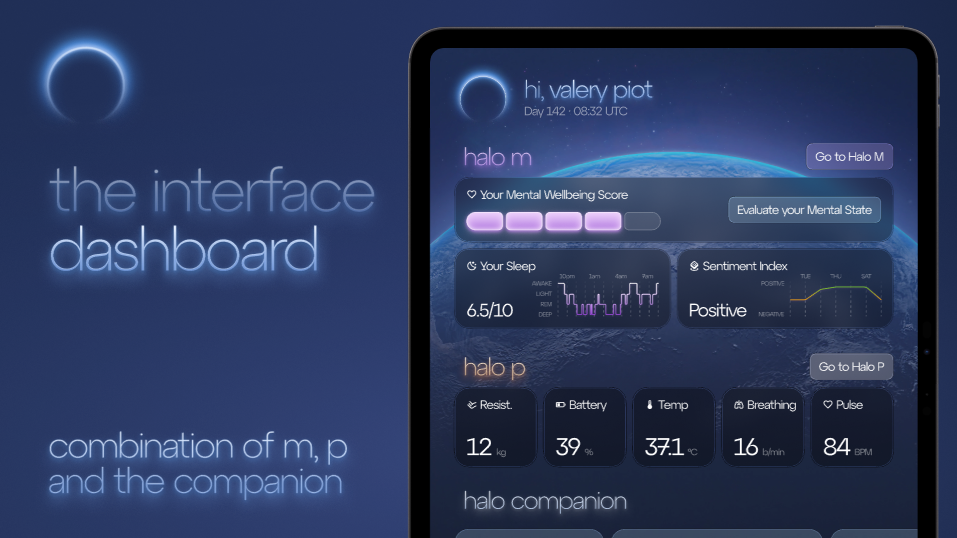
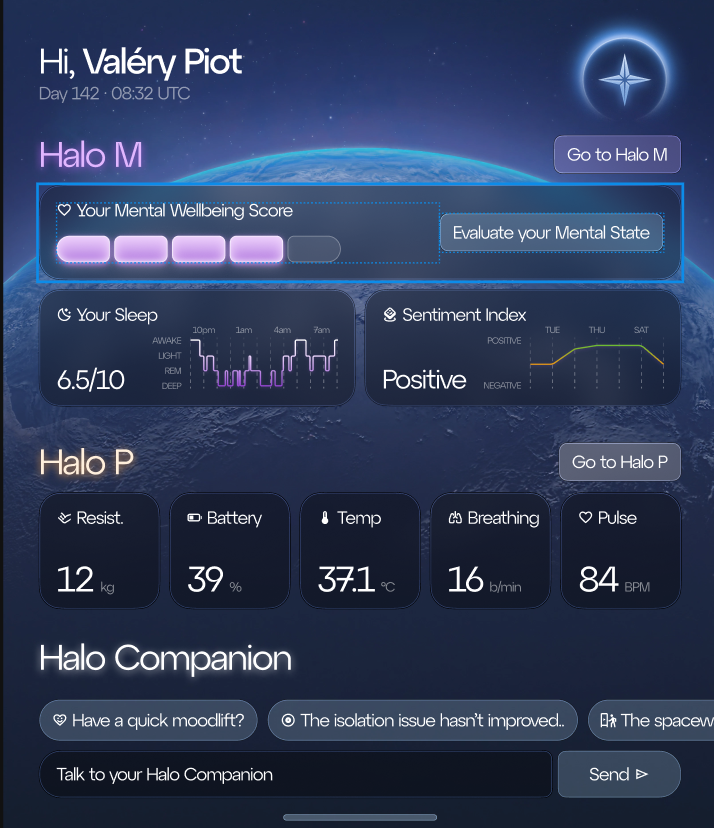
This is a preview of how such an app could look. We designed it in Figma. The screen shown is the dashboard, which combines both Halo-M and Halo-P into one unified system called Halo Companion.
Competitive
As it is one of the most famous hackathons, the competitors were extremely strong. We competed against five other teams. One of them consisted of two full-stack developers, another was made up of four EPFL and ETH students. And then there was us. Just a group of high-school students. So we didn’t really expect to win. But we didn’t give up. We prepared intensively for the pitch, which Jakob delivered. We created a high-level, well-designed branding and pitch deck. Jakob presented with passion, stood fully behind the idea, and motivated everyone around him.
Evaluation
After the evaluation by Starlab Space and professors from the EPFL Space Center, we actually won first place and were invited to the Starlab User Interface Conference in Berlin. More about the conference can be found on this page: here.